Nara: Japan's First Permanent Capital
 Nara Deer
Nara served as Japan's capital from 710 to 784 CE, a 74-year period that proved foundational for Japanese state formation. Though brief compared to Kyoto's millennium-long reign, the Nara period established administrative structures, religious institutions, and written records that would shape Japan for centuries afterward.
Heijō-kyō: The First Planned Capital
Before Nara, Japanese emperors had moved the capital with each succession—partly for ritual reasons, partly to escape political entanglements. Emperor Genmei broke this pattern in 710 by establishing Heijō-kyō (the historical name for Nara), modeled on the Tang Chinese capital of Chang'an.
The city was laid out on a grid approximately 5 by 6 kilometers, with the imperial palace at the northern center. Government ministries, aristocratic residences, and Buddhist temples filled the planned blocks. At its peak, the population reached an estimated 100,000—making it one of the largest cities in the world at that time.
The capital moved to Nagaoka and then Kyoto in 784, deliberately distancing the court from the powerful Buddhist institutions that had accumulated influence during the Nara period. The city subsequently declined to a temple town, which paradoxically preserved many of its original structures as the surrounding land was never redeveloped.
Tōdai-ji and the Great Buddha
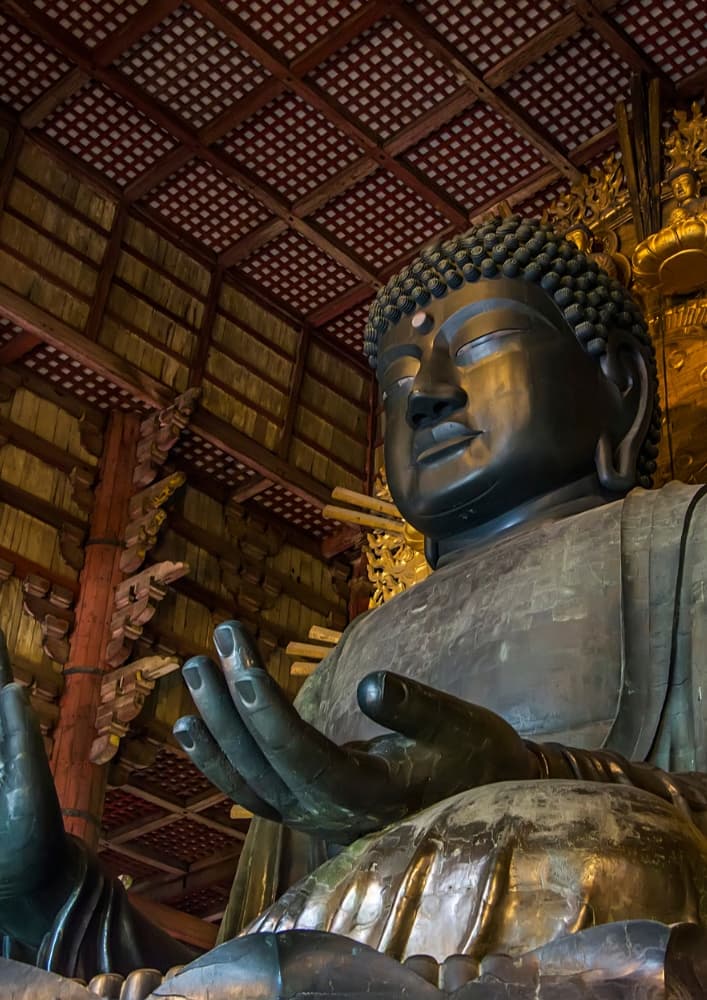
Emperor Shōmu ordered the construction of Tōdai-ji in 752 as the headquarters of a nationwide network of provincial temples. The project consumed most of Japan's bronze production capacity—the Great Buddha (Daibutsu) statue required an estimated 500 tons of bronze and 130 kilograms of gold for gilding. The casting process took over a decade and multiple attempts.
The seated Buddha represents Vairocana, the cosmic Buddha in Mahayana Buddhism. At 15 meters tall, the statue remains one of the world's largest bronze figures. The hands alone are over 2 meters wide. A popular legend holds that crawling through a hole in one of the hall's pillars (the same dimensions as the Buddha's nostril) guarantees enlightenment—a feat primarily attempted by children and flexible tourists.
The Daibutsuden (Great Buddha Hall) was historically the world's largest wooden building. The current structure, rebuilt in 1709, is approximately two-thirds the size of the original—yet still measures 57 meters wide and 50 meters tall.
The Deer of Nara Park
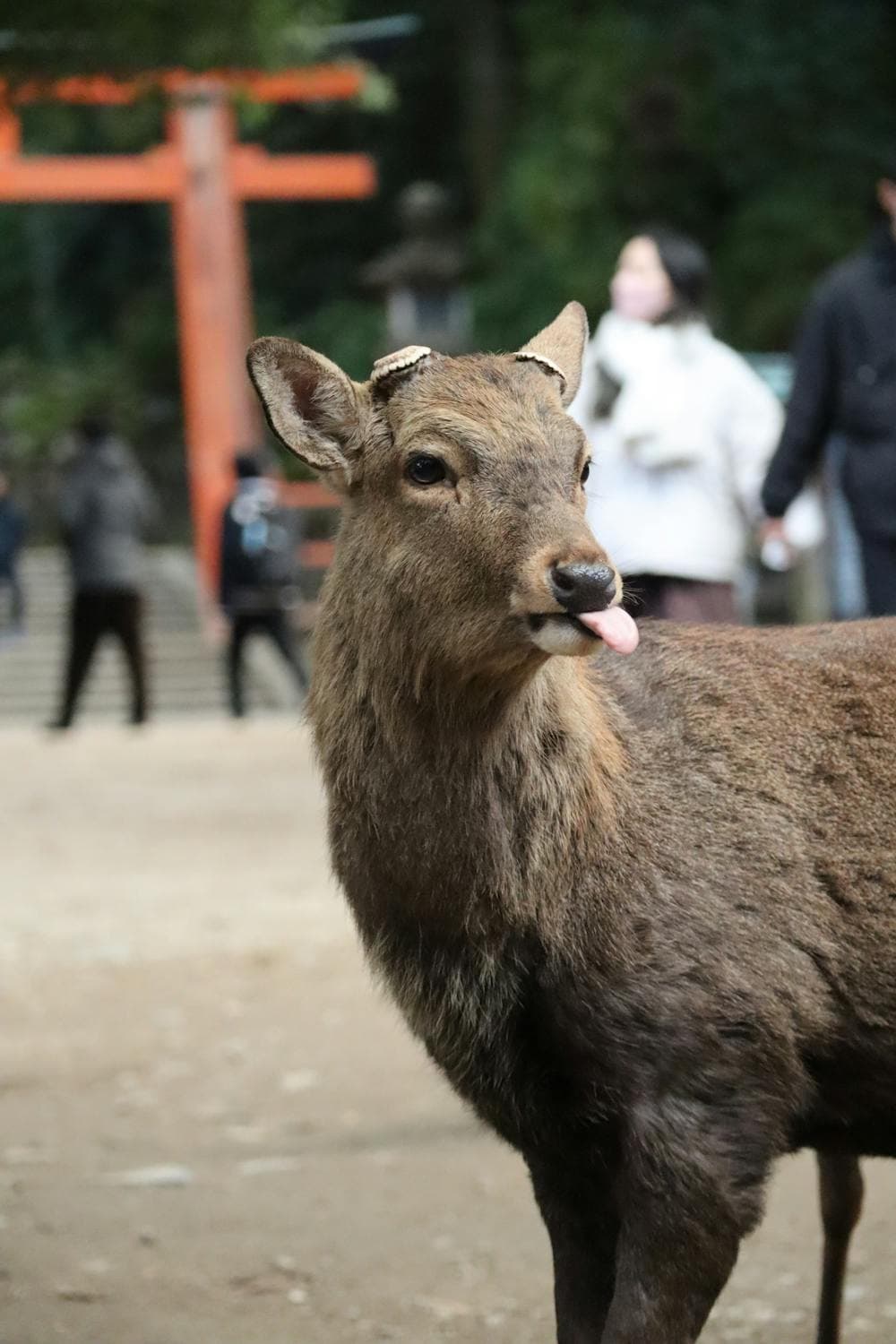
Approximately 1,200 deer roam freely through Nara Park and the surrounding temple grounds. According to Shinto tradition, a deity arrived in Nara riding a white deer in 768 CE, leading the animals to be considered divine messengers and protected for centuries. Killing a deer was a capital offense during the feudal period.
The deer are officially designated as national natural treasures, though they are technically wild animals. Vendors sell special shika senbei (deer crackers) approved by the Nara Deer Preservation Foundation—the only food visitors should offer them. The deer have learned to bow in exchange for crackers, a behavior that appears charming but is essentially a learned begging technique.
Textual Legacy
The Nara period produced Japan's earliest surviving written histories: the Kojiki (712 CE) and Nihon Shoki (720 CE), which compiled origin myths and imperial genealogies. The Man'yōshū poetry anthology, compiled around 759 CE, contains over 4,500 poems and provides the earliest substantial examples of Japanese literary expression.
These texts were written using Chinese characters adapted to represent Japanese sounds—a complex system that would eventually evolve into the mixed script still used today.
Visiting Today
Modern Nara city has approximately 360,000 residents, a manageable size that allows most major sites to be visited on foot. The core temples and Nara Park cluster within a 2-kilometer radius east of Kintetsu Nara Station. Tōdai-ji, Kōfuku-ji, and Kasuga Taisha (a Shinto shrine famous for its hundreds of stone and bronze lanterns) form the primary circuit.
From Kyoto, Nara is approximately 45 minutes by train; from Osaka, about 40 minutes. Day trips are common, though staying overnight allows time for less-visited temples and a quieter experience of the deer park at dawn or dusk.